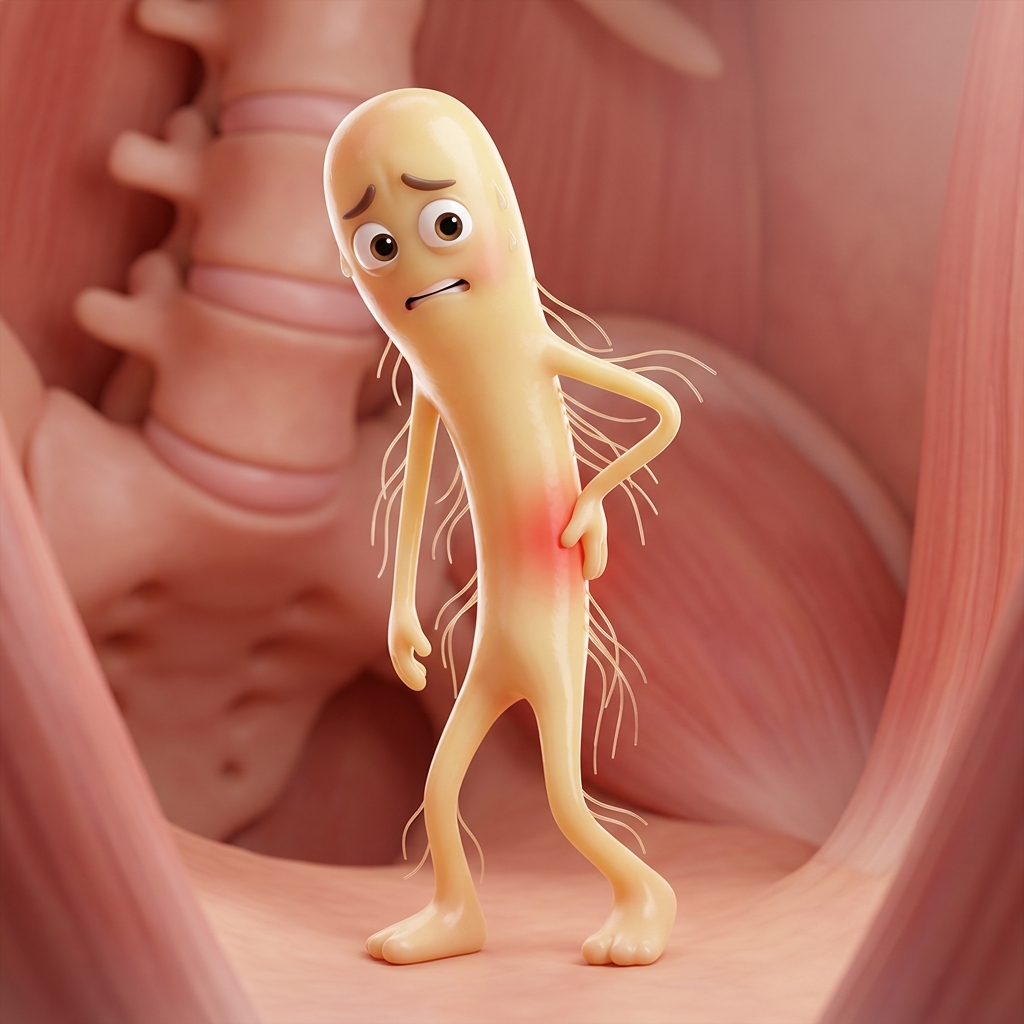




Art style: 3D Pixar. Full-length view, the entire figure visible from head to feet, standing upright, figure centered — a friendly anthropomorphized sciatic nerve character. His body is a long, glossy pale-yellow nerve fibre, thick and cord-like, with a rounded head merging into a slender trunk that splits and tapers into two nerve-branch legs ending in soft rounded pad-feet, like little bare nerve tips. Fine translucent filament strands sprout along his sides like fringed threads. Big expressive round eyes, arched worried brows, small mouth wincing in pain, a light sheen of sweat. One flexible arm-branch clutches his lower back where a red inflamed pinched spot glows sore. His posture is hunched, leaning, favoring one leg. Setting: a soft warm interior of a human lower back and thigh, curved pinkish spinal vertebrae and muscle walls around him, gentle diffuse light. ━━━━━━━━━━━━━━━━━━━━━━━━━━━━━━━━━━━━━━ FINAL STYLE ENFORCEMENT (this is the authoritative rendering directive — it overrides any style wording elsewhere in the prompt): Render this image in the following art style: Pixar-style 3D computer animation (Pixar / Disney feature-film look) — fully volumetric 3D rendering with rounded dimensional forms, soft subsurface-scattering skin, physically based materials, soft global illumination, warm cinematic key light, gentle depth of field, vibrant family-friendly colours. CRITICAL: EVERY element — characters, foliage, trees, animals, water, sky, props and the entire environment — must be rendered as polished 3D CGI with real depth and form. This is NOT flat 2D illustration, NOT a watercolour or storybook painting, NOT cel-shaded anime. Every surface, skin, fabric, material, and environmental element must be rendered in this idiom.
Free to start · Generate videos and images with AI in seconds